Singapore InvoiceNow: The Complete GST E-Invoicing Compliance Guide for 2026–2031
Singapore’s GST InvoiceNow mandate is live. Learn who must comply, key 2026–2031 deadlines, PINT-SG format, Peppol 5-corner model & how to get compliant fast.
Everything GST-Registered Businesses in Singapore Need to Know - Deadlines, Formats, Exemptions, and How to Get Ready
Singapore’s InvoiceNow mandate is no longer a future obligation - it is happening now. As of 1 April 2026, all new voluntary GST registrants are required to transmit invoice data to the Inland Revenue Authority of Singapore (IRAS) via the InvoiceNow network.(source)
For the thousands of GST-registered businesses not yet in scope, the phased rollout extending to April 2031 means that preparation cannot be deferred.
This guide covers everything finance leaders, business owners, and compliance teams need to know: what InvoiceNow actually is, how it differs from the older B2B exchange model, which businesses are in scope, what the exact deadlines are, what the PINT-SG format requires, who is exempt, and what practical steps get you compliant without disrupting existing operations.
What Is InvoiceNow? Singapore’s National E-Invoicing Network Explained
InvoiceNow is Singapore’s nationwide e-invoicing infrastructure, launched by the Infocomm Media Development Authority (IMDA) in 2019. It is built on the internationally recognized Peppol standard - the same framework used across the European Union, Australia, New Zealand, Japan, and Malaysia for structured electronic invoice exchange.
What makes InvoiceNow different from simply emailing a PDF is fundamental: it connects the accounting systems of buyers and suppliers directly, transmitting invoices as structured, machine-readable XML data rather than static image files. An invoice transmitted via InvoiceNow arrives at the recipient’s system as data that can be automatically validated, matched against purchase orders, and processed without human re-entry.
Singapore was the first country outside Europe to adopt Peppol as a national e-invoicing standard. Since IMDA became a Peppol Authority in May 2018, the network has grown from a voluntary business efficiency initiative into the foundation of Singapore’s digital tax administration strategy.
The Difference Between InvoiceNow and GST InvoiceNow
This distinction matters enormously for compliance planning, and many businesses conflate the two:
InvoiceNow is the e-invoicing exchange network - the infrastructure through which suppliers send structured invoices to buyers. It was launched in 2019 and operated initially on the Peppol 4-corner model.
GST InvoiceNow is the IRAS compliance requirement layered on top of InvoiceNow. It requires GST-registered businesses to transmit a copy of their invoice data to IRAS - not just to their trading partner - through the same network. This introduces the Peppol 5-corner model, where the fifth corner is IRAS receiving structured invoice data for GST reporting purposes
This represents a structural shift from periodic GST reporting (where businesses submit GST returns quarterly) toward continuous transaction controls (CTC) - a model where tax authorities receive transaction data in near real-time. Singapore’s GST InvoiceNow Requirement is the clearest signal yet that CTC is the direction of Singapore’s tax administration future.
The Singapore InvoiceNow Peppol 5-Corner Model Explained
Understanding the technical architecture of InvoiceNow is essential for evaluating what systems changes your business needs to make.
How the 5-Corner Model Works
The traditional Peppol model used by InvoiceNow from 2019 was a 4-corner model:
- Corner 1 : The supplier creates a structured invoice in their accounting or ERP system
- Corner 2 : The supplier’s IMDA-accredited Access Point transmits the invoice over the Peppol network
- Corner 3 : The buyer’s accredited Access Point receives and delivers the invoice
- Corner 4 : The buyer’s accounting system processes the invoice automatically
The 5-corner model adds:
Corner 5 : A copy of the structured invoice data is simultaneously transmitted to IRAS for GST reporting and audit purposes
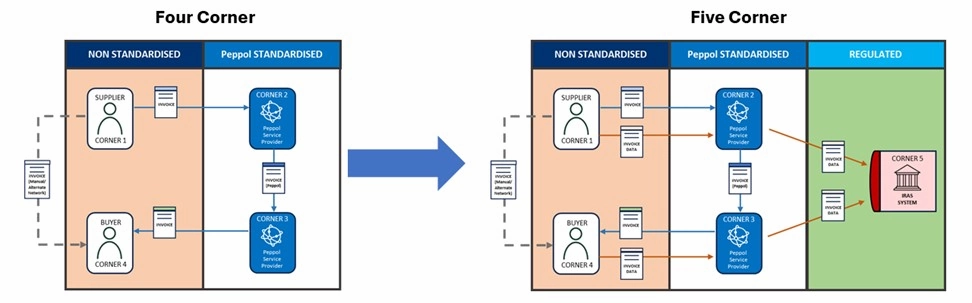
This fifth corner is what defines the GST InvoiceNow Requirement. When your business transmits an invoice via an InvoiceNow-Ready Solution, the solution automatically sends the GST-relevant data to IRAS before or by the filing date of the relevant GST return.
What Role Do Accredited Access Point Providers Play?
Access Point (AP) providers are the companies certified by IMDA to connect businesses to the InvoiceNow/Peppol network. They validate invoice formats, route transmissions to the correct recipient, ensure compliance with Peppol standards, and maintain the connectivity gateways required for the network to function.
All Access Point Providers have undergone an extensive IMDA accreditation process. IMDA published its official list of accredited InvoiceNow-Ready Solution Providers (IRSPs) and Access Point Providers. Businesses subject to the mandate must use only IMDA-accredited solutions. Non-accredited software platforms, however feature-rich, will not fulfil the compliance obligation.
Singapore InvoiceNow Compliance Deadlines: The Full 2025–2031 Timeline
The GST InvoiceNow Requirement is being implemented in a structured phased rollout, allowing businesses at different stages of digital maturity to prepare appropriately.
Phase 1 [Already Implemented] - Already Mandatory (November 2025 and April 2026)
1 November 2025: Mandatory for companies that register for GST voluntarily within 6 months of incorporation date.
1 April 2026: Mandatory for ALL new voluntary GST registrants, regardless of incorporation date or business structure. This includes limited liability partnerships, sole proprietorships, and partnerships
If your business voluntarily registered for GST on or after 1 April 2026, you are already subject to the GST InvoiceNow Requirement under phase-1. Contact us today to collaborate.
Phase 2 - Existing Businesses: April 2028 Onwards
Following the Ministry of Finance’s Committee of Supply (COS) 2026 Debate, IRAS confirmed the extended rollout to all remaining GST-registered businesses:
| Phase | Date | Scope |
|---|---|---|
| Phase 2 | 1 April 2028 | All new compulsory GST registrants + existing GST-registered businesses with total annual supplies ≤ $ 200,000 |
| Phase 3 | 1 April 2029 | Existing GST-registered businesses with total annual supplies ≤ $ 1 million |
| Phase 4 | 1 April 2030 | Existing GST-registered businesses with total annual supplies ≤ $ 4 million |
| Phase 5 | 1 April 2031 | All remaining GST-registered businesses with total annual supplies > $ 4 million |
Important : IRAS will notify existing GST-registered businesses of their specific go-live date by mid-2026. Businesses can also use IRAS’s published Excel-based GST InvoiceNow Implementation Date Calculator to determine their applicable phase.
How to Determine Your Implementation Phase
Your applicable phase is based on your total annual supplies - meaning the total value of standard-rated, zero-rated, and exempt supplies made in all prescribed accounting periods ending in calendar year 2025. Check your GST F5 returns for that period to calculate this figure.
Who Is in Scope? Defining the Full Compliance Obligation
Businesses That Must Comply
The GST InvoiceNow Requirement applies to:
All GST-registered businesses with annual taxable supplies exceeding SGD 1 million (compulsory registrants).
All businesses that voluntarily register for GST, starting from their respective phase dates.
Foreign entities that are registered for GST in Singapore and make taxable outward supplies to Singapore-based customers.
Businesses of any structure - companies, LLPs, sole proprietorships, and partnerships.
Transactions That Are In-Scope
Nearly all transactions subject to GST must be captured and transmitted via InvoiceNow:
Standard-rated supplies
Zero-rated supplies
Exempt supplies
Standard-rated purchases
Zero-rated purchases
The Transmission Deadline: When Must Invoice Data Reach IRAS?
Invoice data must be transmitted to IRAS no later than the earlier of: - The GST return filing date for the accounting period in which the transaction occurred, or - The statutory deadline for that GST return
For example: if Company A issues a tax invoice on 20 March 2026 and files its GST return for the period 1 January to 31 March 2026 on 20 April 2026, the invoice data must be transmitted to IRAS by 20 April 2026.
Who Is Exempt? InvoiceNow Exclusions Explained
Not every GST-registered entity falls within the mandate. IRAS has defined specific categories of “Excluded Businesses”:
Overseas Vendor Registration (OVR) Suppliers
Foreign businesses registered under the OVR regime - those that sell digital services or low-value goods (LVG) to consumers in Singapore - are excluded from the InvoiceNow Requirement. While OVR suppliers report GST, their transactions are consumer-facing B2C sales that do not require individual invoice submissions through InvoiceNow.
Reverse Charge-Only Registrants
Businesses that registered for GST solely to account for the reverse charge on imported services - without making any taxable outward supplies themselves - are excluded. This commonly applies to financial institutions and certain holding companies.
What About B2C Transactions?
InvoiceNow covers B2B transactions only. Business-to-consumer (B2C) invoices remain outside the InvoiceNow mandate. However, for high-volume consumer businesses, IRAS provides important accommodation: periodic aggregated entries.
POS and Aggregated Entries: Retailers and high-volume low-value transaction businesses can aggregate multiple small transactions - such as daily point-of-sale cash sales - into a single consolidated invoice entry for transmission to IRAS. This avoids requiring individual invoice submissions for thousands of daily retail transactions, while still meeting the data reporting obligation.
The PINT-SG Format: What Your Invoices Must Look Like
What Is PINT-SG?
PINT-SG (Peppol InvoiceNow Template – Singapore) is the structured XML invoice format mandatory for the GST InvoiceNow Requirement from 2025. It is Singapore’s specialization of the international PINT (Peppol INTernational) framework, adapted to align with Singapore’s GST obligations and IRAS reporting requirements.
PINT-SG replaces the earlier SG Peppol BIS Billing 3.0 format, which was used from InvoiceNow’s launch in 2019. While no official deprecation date for BIS 3.0 has been set, all IMDA-accredited solution providers have been required to support PINT-SG since April 2025.
PDF invoices and other unstructured file formats are not compliant under the GST InvoiceNow Requirement - regardless of whether they are digitally signed.
Mandatory Data Elements (MDEs) for PINT-SG Invoices
A compliant InvoiceNow (PINT-SG) invoice must include, at minimum, the following data elements:
| Mandatory Invoice Fields |
|---|
Supplier’s legal name and address |
Supplier’s GST registration number (where applicable) |
Buyer’s legal name and address |
Buyer’s GST registration number (where applicable) |
Supplier and buyer Peppol identifiers (e.g., UEN-based Peppol ID) |
Unique invoice number |
Invoice issue date |
Description of goods or services supplied |
Quantity and unit price (where applicable) |
Applicable GST rate and GST amount (per line item and/or summary level) |
Invoice totals, including:
|
Currency code |
Payment terms and due date (where applicable) |
Note: The exact mandatory fields are defined under the IRAS GST InvoiceNow Requirement and PINT-SG specification. Some fields may be conditional depending on transaction type, GST treatment, or business scenario. (source)
What Is a Peppol ID (UEN) in Singapore?
In Singapore’s InvoiceNow network, a business's Peppol ID is derived from its Unique Entity Number (UEN) - the identification number issued by ACRA to all registered Singapore entities. The UEN functions as your permanent digital address on the Peppol network. Every invoice transmitted through InvoiceNow carries the sender’s and recipient’s Peppol IDs to ensure accurate routing.
Cross-Border InvoiceNow: Transacting with International Partners
One of InvoiceNow’s significant but underappreciated capabilities is its support for cross-border structured invoice exchange. Because InvoiceNow is built on the global Peppol framework, Singapore businesses connected to InvoiceNow can exchange compliant e-invoices with Peppol-registered entities in any other Peppol-connected jurisdiction - using the same connection used for domestic transactions.
Countries currently connected to the Peppol network include Australia, New Zealand, Japan, Malaysia, and most European Union member states. For Singapore businesses with trading partners in these markets, this means:
No separate bilateral integration agreements are needed
Your domestic InvoiceNow Peppol ID works for international invoicing
Invoice format interoperability is handled at the network level
For multinational enterprises, this positions Singapore InvoiceNow readiness as a strategic investment - not just a local compliance exercise. As more governments mandate e-invoicing on Peppol infrastructure, a Singapore-compliant Access Point connection provides a ready foundation for multi-jurisdiction compliance.
Benefits of InvoiceNow Beyond Compliance
Compliance is the driver, but it is far from the only reason to implement InvoiceNow promptly. Businesses that completed IRAS’s InvoiceNow pilot trials reported tangible operational gains across three dimensions.
Fewer Audits and Faster GST Refunds
Because IRAS receives structured invoice data in advance of GST return filing, the tax authority can cross-check return submissions against actual transaction data automatically. This reduces the need for manual GST audits. For businesses that regularly claim GST refunds - particularly zero-rated exporters - the verification process can be significantly accelerated, with refunds processed faster where invoice data already on record supports the claim.
Automated Invoice Processing
The shift from PDF to structured XML fundamentally changes the accounts payable workflow. Instead of a finance team member manually keying invoice data from a PDF into an ERP system, the structured InvoiceNow invoice arrives as data that can be validated, matched, and posted automatically. For businesses processing hundreds of supplier invoices monthly, the time savings are substantial.
Error Reduction and Faster Payment Cycles
Automated validation happens at the point of transmission - before the invoice leaves your system. Format errors, missing GST numbers, and incorrect field entries are caught before the invoice reaches your customer. The result is fewer rejected invoices, fewer follow-up cycles, and faster payment approvals from buyers whose systems process structured data without human review queues.
Supply Chain Visibility
When invoice data flows automatically between accounting systems, both buyer and supplier gain real-time visibility into invoice status. Payment disputes shrink. Reconciliation becomes faster. For Singapore SMEs managing receivables across multiple large corporate clients, the impact on working capital can be meaningful.
How to Comply: A Step-by-Step InvoiceNow Implementation Guide
Step 1: Determine Your Go-Live Date
Use IRAS’s GST InvoiceNow Implementation Date Calculator (available on the IRAS website) to determine which phase applies to your business. If you voluntarily registered for GST on or after 1 April 2026, you are already in Phase 1.
Step 2: Choose an IMDA-Accredited InvoiceNow-Ready Solution Provider (IRSP)
Your InvoiceNow solution must come from an IMDA-accredited IRSP or Accredited Access Point Provider. When evaluating providers, consider:
Integration compatibility with your existing ERP or accounting software (SAP, Oracle, Xero, QuickBooks, etc.)
Support for PINT-SG format
ELMA/SG Peppol Directory registration handling
Cross-border Peppol capability
Pricing model and transaction volume fit
Level of ongoing compliance monitoring and update support
The IMDA publishes and maintains the official list of accredited IRSPs and Access Point Providers on its website.
Step 3: Obtain Your Peppol ID via CorpPass
The SG Peppol Directory account is provided to registered users only. To create an account, please fill out the form found at URL ⇨ www.peppoldirectory.sg/signup and complete the registration process.
Step 4: Configure Your Invoicing System for PINT-SG Output
Work with your IRSP or ERP vendor to ensure your invoicing module can generate PINT-SG-compliant XML output. This involves verifying that all mandatory data elements are correctly mapped, that GST category codes align with IRAS requirements, and that the invoice schema passes validation checks before live transmission begins.
Step 5: Complete Testing and Validation
Before going live, run controlled test transmissions through your IRSP’s testing environment. Validate that invoices route correctly to the SG Peppol Directory, that data is formatted correctly, and that the GST InvoiceNow reporting flow to IRAS functions as expected.
Step 6: Go Live and Monitor
Once live, implement ongoing monitoring for transmission failures, format rejections, and deadline compliance. Your IRSP should provide reporting dashboards and alerts. Remember that IRAS requires invoice data to be transmitted no later than the GST return filing date - late submissions are a compliance risk.
What If You Make Errors on Submitted Invoices?
IRAS has been clear that businesses remain responsible for their GST obligations even after implementing InvoiceNow. If errors are made on transmitted invoices - whether overclaimed input tax or under-accounted output tax - businesses can use IRAS’s Voluntary Disclosure Programme to disclose and correct them.
Errors voluntarily disclosed within the grace period may qualify for penalty waivers or reduced penalties, subject to VDP conditions. IRAS has also signalled a calibrated lenient approach in the initial implementation stages, prioritising education for compliant taxpayers over enforcement. However, this leniency is not guaranteed beyond the early phases and should not be relied upon as a substitute for proper compliance.
How InvoiceNow Biz Supports Your InvoiceNow Journey
At InvoiceNow Biz, we work with Singapore-based businesses and regional enterprises to design, implement, and manage InvoiceNow compliance solutions that integrate cleanly with existing finance systems.
Our Singapore e-invoicing services include:
Compliance readiness assessment - determining your applicable phase, current system gaps, and priority actions.
IRSP/Access Point evaluation and selection - matching your business with the right accredited provider based on ERP, volume, and cross-border requirements.
ERP integration and PINT-SG configuration - including SAP, Oracle, Microsoft Dynamics, Xero, and other platforms.
CorpPass and SG Peppol Directory registration support.
Invoice transmission monitoring and compliance reporting.
Cross-border Peppol strategy for businesses trading across Singapore, Australia, New Zealand, Japan, Malaysia, and EU markets.
Whether you are a new voluntary GST registrant navigating Phase 1 obligations or an enterprise preparing for the April 2028 or later phase, we provide the technical and compliance expertise to move from obligation to operational efficiency.
Frequently Asked Questions About Singapore InvoiceNow
Ready to Start Your E-invoicing Journey?
InvoiceNow Biz can help you prepare for the Singapore GST InvoiceNow requirement.
Contact Us for a Free AssessmentRelated Articles
PINT-SG Explained: Singapore's Peppol Invoice Format
What PINT-SG is, why it replaced SG Peppol BIS Billing 3.0, and the data your e-invoices must carry to satisfy the IRAS GST InvoiceNow Requirement.
Read moreHow-ToHow to Get Your Singapore Peppol ID and Join the InvoiceNow Network
Your Peppol ID is your digital address on InvoiceNow. Here's how it's derived from your UEN, how registration works through an accredited Access Point, and the role of Corppass and the SG Peppol Directory.
Read moreComplianceWho's Exempt from Singapore's GST InvoiceNow Requirement?
Most GST-registered businesses are in scope, but not all. A plain-English look at OVR suppliers, reverse-charge-only registrants, and why B2C sits outside InvoiceNow.
Read more